A Kentucky accident report can help document who was involved in a crash, where and when it happened, what the responding officer observed and other information collected during the investigation. Drivers may need the report for an insurance claim, a vehicle-damage dispute or a potential injury case. Getting a copy usually starts with identifying the law enforcement agency that prepared it. If the report contains an error, the correction request generally must go back to that agency rather than being changed directly by the driver.
Determine Which Type of Report Was Filed
The first step is to determine whether a police officer investigated the collision or whether a driver submitted a civilian report.
Under Kentucky Revised Statutes Section 189.635, a law enforcement officer who investigates a qualifying collision files a written report through the officer’s agency. The agency must then submit the report to the Kentucky State Police reporting system within 10 days after its investigation.
A different process applies when no officer investigates. Kentucky law requires a driver to submit a written report to KSP within 10 days when a collision on a Kentucky highway causes more than $500 in property damage and no law enforcement investigation occurs. The KSP civilian collision report guidance also explains that a driver should not file a second civilian report when an officer responded and said the officer would complete the report. KSP advises allowing 10 days for that officer-prepared report to become available.
This distinction matters because it determines where to request the record and who can address a possible mistake.
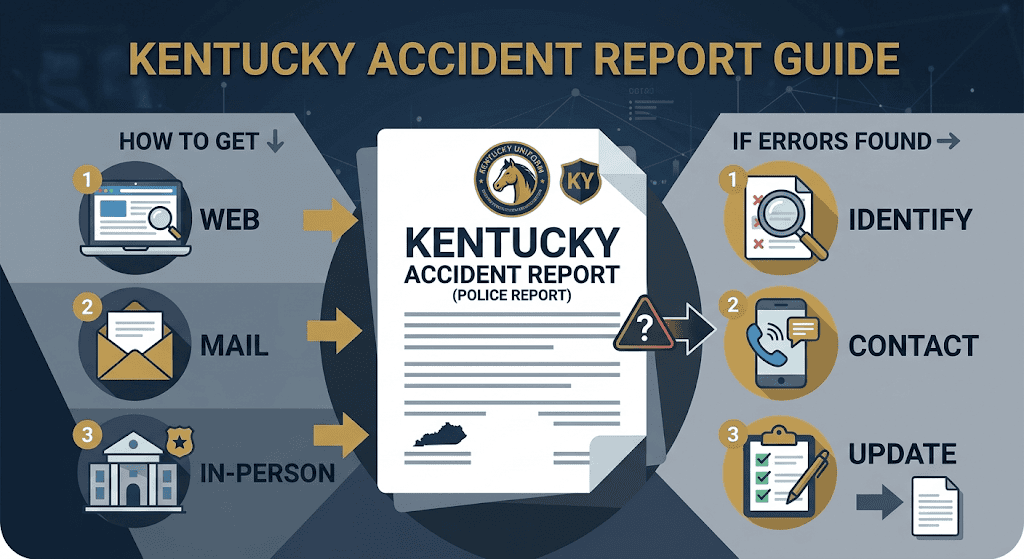
How To Get a Kentucky Accident Report
For an officer-prepared Kentucky accident report, start with the agency that investigated the crash. The report number, officer’s name, agency name, crash date and location can make the search easier. If that information is not available, contact the agency’s records unit and provide as much identifying information as possible.
The Kentucky State Police open records request instructions state that accident reports may be obtained through BuyCrash or by sending a written request to the KSP Official Custodian of Records. The request should identify the record as specifically as possible and include information such as the name, date and location, along with the requester’s contact information. Kentucky law limits access to these reports, but authorized recipients include the parties to the collision, parents or guardians of an involved minor, insurers and attorneys representing the parties.
Local procedures can differ. For example, the Louisville Metro Police Department accident report process directs users to an online portal and lists the report number, report date and driver’s or vehicle owner’s last name as search information. LMPD also provides contact instructions for someone who does not know the report number. A person seeking a Kentucky police report after a car accident should therefore check the investigating agency’s current instructions rather than assuming every department uses the same system.
A civilian filer should save the downloaded report after submitting it. If it was not saved, KSP directs the filer to use the open records process to request a copy.
Review the Report Carefully
Once the report is available, compare it with the information and evidence already in hand. Review the names of the drivers and passengers, vehicle descriptions, insurance information, date, time, location, roadway details, diagram, narrative and any listed witnesses or citations.
Not every disagreement is the same. A misspelled name, incorrect plate number, wrong vehicle model or inaccurate insurance entry is a factual issue that may be supported with documents. A disagreement about vehicle movement, lane position or how the collision occurred may require photographs, video, witness information or other evidence.
A police report can be important, but it is not the only information considered in a Kentucky car crash claim. Photos, medical records, vehicle damage, witness accounts, electronic data and other records may also affect how the facts are evaluated.
What To Do if the Report Contains an Error
Kentucky’s official KYOPS collision-report guidance states that a traffic collision report is a legal document and that corrections must be made by the submitting agency. Because the submitting agency controls the correction process, a driver generally cannot edit an officer-prepared report through KSP or an online report vendor.
Contact the investigating agency’s records unit or the officer identified on the report. The request should be specific and organized. Include:
- The report or master file number
- The crash date and location
- The exact field, sentence or diagram detail believed to be incorrect
- The corrected information
- Copies of documents or evidence supporting the requested change
- Current contact information for follow-up
Keep the tone factual. Instead of asking the agency to “fix the whole report,” identify each claimed error separately. For example, attach a driver’s license to support a name correction, a registration to verify vehicle information or photographs to explain a disputed location or diagram.
The agency will decide whether to change the official report. Request written confirmation of that decision and obtain an updated copy if a correction is made.
Preserve Evidence Even if the Report Is Not Changed
An agency may not agree to every requested revision, particularly when the issue involves competing accounts rather than a verifiable clerical mistake. A refusal to change the report does not prevent a person from preserving evidence that supports a different version of events.
Keep the original report, the written correction request, supporting documents, the agency’s response, photographs, witness contact information, repair records and insurance correspondence. If an insurer already has the report, provide the correction request and supporting materials so the disputed information is documented in the claim file.
Avoid altering the report itself or presenting a personally edited copy as official. Any correction should come from the agency that submitted the record.
Get Help With a Kentucky Accident Report Error
A material Kentucky accident report error can affect how an insurer or another party initially understands the crash. Promptly obtaining the report, documenting the mistake and preserving supporting evidence can help create a clearer record.
Forman & Associates can review a Kentucky police report after a car accident, the surrounding evidence and the steps already taken to request a correction. To discuss the facts of an injury claim, request a free case evaluation.