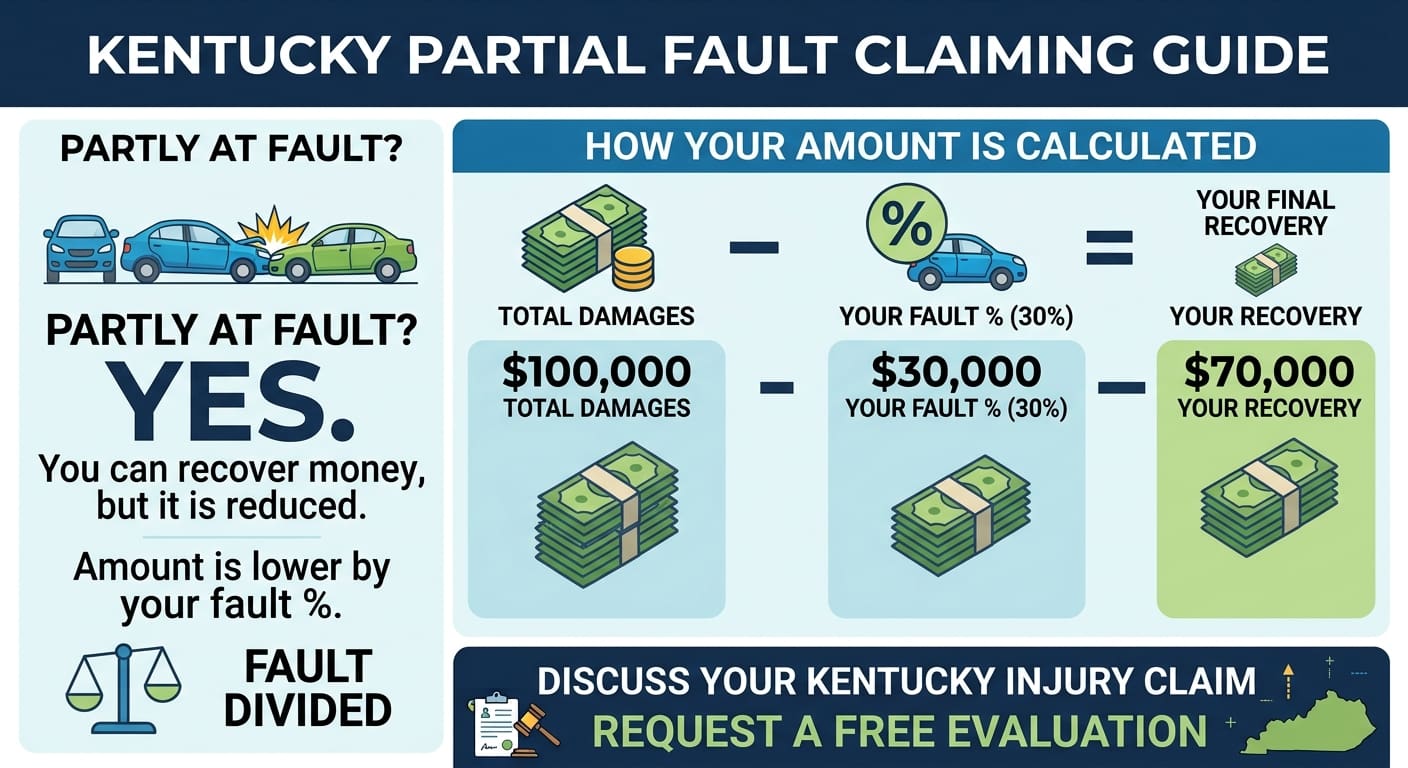
Can you recover compensation if you were partly at fault in a Kentucky car crash? The answer is yes. Being partly responsible for a collision does not automatically prevent an injured person from pursuing compensation in Kentucky. Under Kentucky’s fault-allocation statute, fault may be divided among the parties whose conduct contributed to the crash, including the person making the claim. Any recovery is then generally reduced to reflect that person’s assigned percentage of fault.
That means a disputed lane change, delayed reaction, speeding allegation or other mistake may reduce the value of a claim without necessarily ending it. The important questions are what each person did, how that conduct contributed to the collision and what evidence supports the proposed allocation of fault.
How Kentucky Comparative Negligence (Being Partly at Fault) Works
Kentucky comparative negligence applies when more than one party shares responsibility for a tort claim. When both you or the other driver are determined to be partly at fault for the accident. The fact-finder (jury or judge) determines the total damages without considering the claimant’s fault, assigns a percentage of fault to each relevant partly at fault party and then determines each party’s equitable share of the obligation.
In practical terms, a claimant’s percentage reduces the portion of damages attributable to other responsible parties who were partly at fault. Suppose total damages are found to be $100,000 and the injured person is assigned 30% of the fault. The remaining 70% would be $70,000, subject to insurance limits, available coverage and other case-specific issues.
Kentucky’s current statute does not create an automatic bar merely because the claimant’s assigned share reaches 50% or more. A person who bears most of the responsibility may therefore still have a legally recoverable share, although a high fault percentage can substantially reduce the practical value of the claim.
What Conduct Can Lead to Shared Fault?
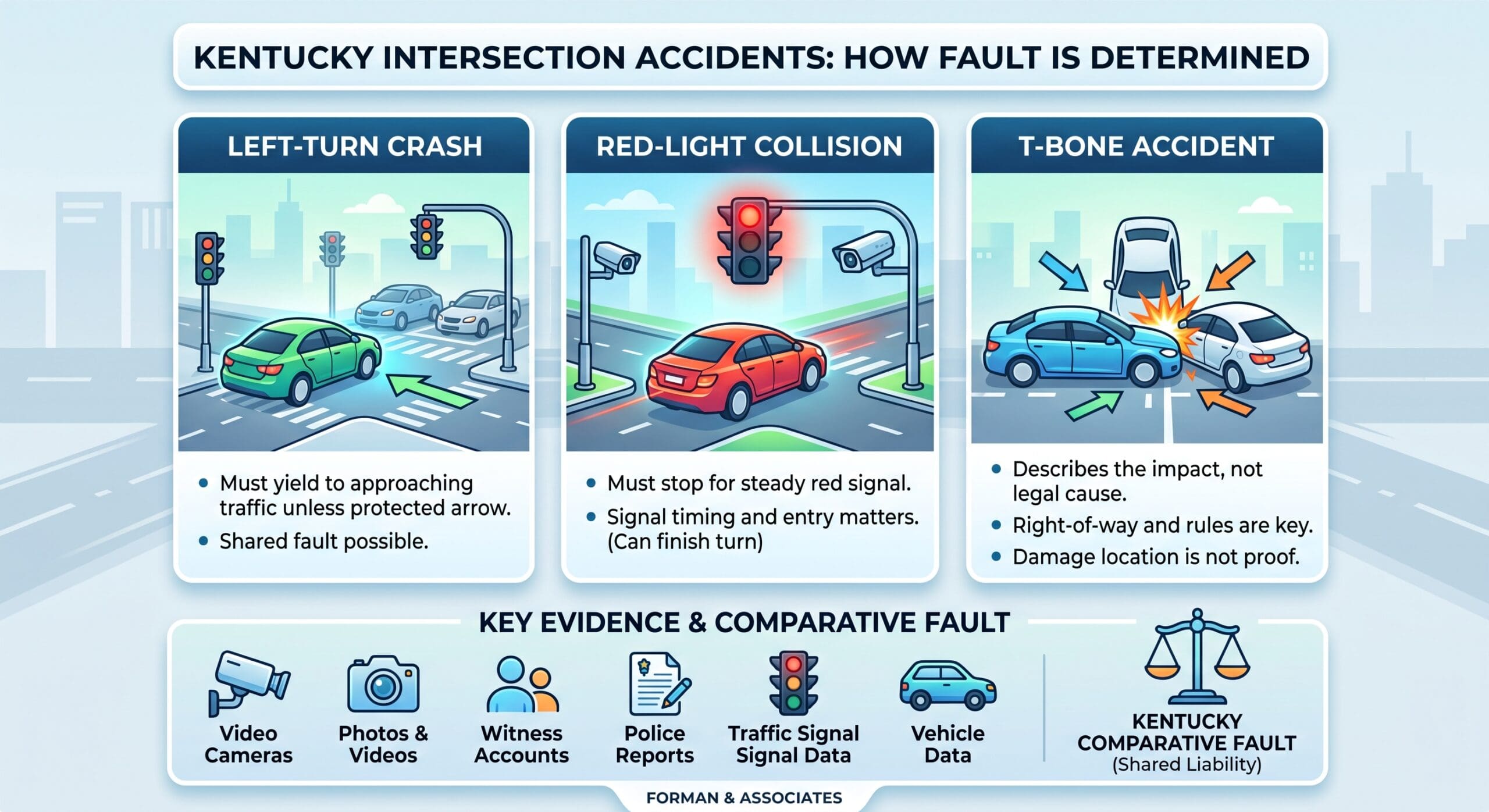
Shared fault can arise when the evidence supports more than one contributing cause. One driver might have been partly at fault because he or she failed to yield while the other was partly at fault for speeding. A rear driver might have followed too closely while the front driver changed lanes without adequate warning. Weather, visibility or roadway conditions may also affect how each driver’s conduct is evaluated, although poor conditions do not automatically excuse unsafe driving.
KRS 411.182 directs the fact-finder to consider both the nature of each party’s conduct and the causal relationship between that conduct and the claimed damages. A traffic citation, police narrative or insurer’s initial opinion may become part of the factual investigation, but none of those items necessarily resolves the final percentage by itself.
A person considering a Kentucky car crash claim should avoid assuming that an apology, citation or statement made at the scene conclusively establishes legal fault. The complete factual record matters.
How Fault Percentage Affects Compensation
Comparative fault can affect settlement negotiations as well as a final court award. When liability is disputed, the parties may disagree sharply about both the claimant’s percentage and the total amount of damages for each partly at fault party. An insurer might argue that the injured person contributed to the crash, while other evidence may support a lower allocation or show that another driver’s conduct played the larger causal role.
Several forms of evidence may help evaluate those arguments:
- Photographs or video showing vehicle positions, impact points, traffic signals and road conditions
- Witness statements from people who saw the collision or the events immediately before it
- Vehicle data, dash-camera footage or available surveillance recordings
- The crash report, citations and diagrams, considered alongside the underlying evidence
- Medical and employment records documenting the losses claimed
- Statements given to insurers or other parties after the crash
Preserving this material can be important because fault percentages are not abstract numbers. Each percentage point assigned to a claimant can affect the amount that may ultimately be recovered.
PIP Benefits and a Liability Claim Are Different Issues
Kentucky’s no-fault framework creates a separate question from comparative negligence. Under the state’s basic reparation benefits statute, a person injured through the use of a motor vehicle in Kentucky generally has a right to basic reparation benefits unless that person rejected the applicable tort limitations before the crash, regardless if they were partly at fault.
These benefits, commonly called PIP, may provide an initial source for certain economic losses without first resolving who caused the collision. Kentucky Department of Insurance guidance on no-fault coverage explains that basic PIP may pay medical expenses, lost wages and similar out-of-pocket costs after an automobile injury regardless of fault. The firm’s article on Kentucky no-fault insurance and PIP benefits addresses that process in more detail.
A separate claim against another driver may depend on Kentucky’s motor-vehicle tort limitations, including the statutory rules governing bodily-injury damages, injury thresholds and any properly filed no-fault rejection. The applicable policy language, the type of losses claimed and the facts of the crash can all affect the analysis. Partial fault does not eliminate those separate coverage and threshold questions.
What if Several People Contributed to the Crash?
Some collisions involve more than two potentially responsible parties. Multiple drivers, a vehicle owner, an employer or another legally responsible person may become relevant depending on the facts. Kentucky’s allocation statute permits fault to be divided among parties to the claim and certain released persons, with each share affecting the resulting judgment.
This can make an early settlement with one party more complicated than it appears. A release may affect the remaining claim based on the released person’s equitable share. Before signing a release or accepting a settlement, the injured person should understand which claims are being resolved and how the agreement could affect recovery from anyone else.
Discuss Kentucky Comparative Negligence With Forman & Associates
A partly at fault car accident in Kentucky requires a fact-specific review of the collision, available evidence, insurance coverage and the losses being claimed. An initial allegation of fault does not necessarily establish the percentage that should govern the claim.
Forman & Associates can review the facts of a Kentucky injury matter and explain how Kentucky comparative negligence may affect the available options. To discuss a crash involving disputed or shared responsibility, request a free case evaluation.