An intersection crash in Kentucky can look straightforward at first. One vehicle may have turned across traffic, entered on a red light, or struck the side of another vehicle, but the location of the damage alone does not decide legal fault.
Kentucky fault analysis generally starts with the traffic rules that applied to each driver and the evidence showing what happened. Left-turn and red-light rules can be especially important, while Kentucky’s comparative-fault law allows responsibility to be divided when more than one person contributed to a crash.
Fault Depends on the Traffic Rule and the Evidence
Kentucky law requires drivers to operate carefully and not drive recklessly or negligently in a way that endangers people or property. The state also has specific right-of-way and traffic-signal rules for intersections.
That means fault after an intersection crash is not determined simply by which vehicle was hit in the front, side, or rear. The central questions are usually which driver had the right-of-way, whether anyone violated a traffic rule, and whether that conduct caused or contributed to the collision.
For a Kentucky car crash claim, those questions may require looking beyond the drivers’ competing descriptions of the event.
Who Is Generally Responsible for a Left-Turn Crash?
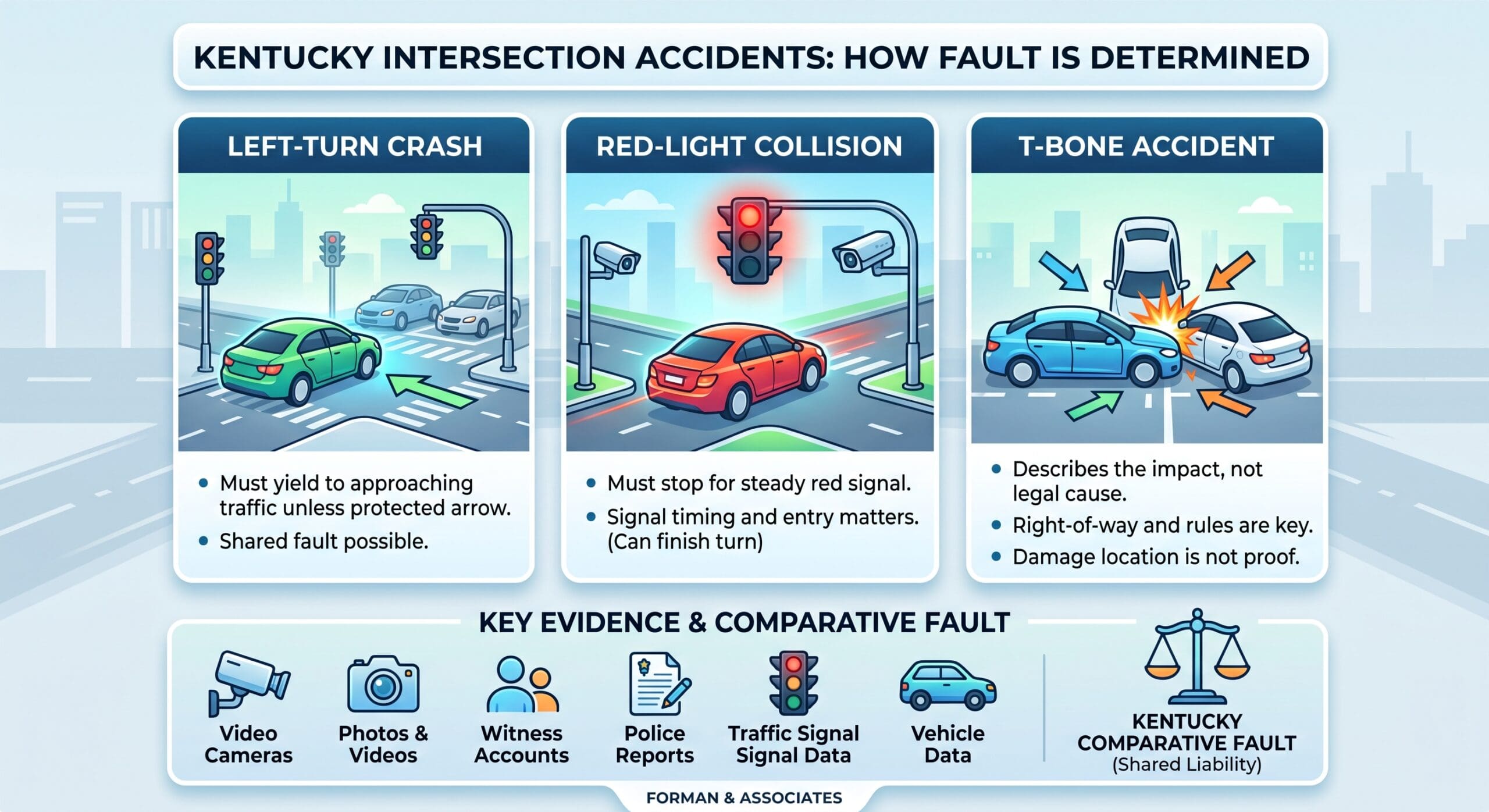
Under Kentucky’s intersection right-of-way statute, a driver making a left turn must yield when an approaching vehicle is already in the intersection or close enough to present an immediate hazard.
As a result, left-turn accident fault in Kentucky often centers on whether the turning driver yielded before crossing the path of approaching traffic. If a driver turns left directly in front of an oncoming vehicle that had the right-of-way, the turning driver may bear substantial responsibility for the crash.
However, the left-turning driver is not automatically assigned all of the fault in every collision that occurs, as the conduct of the oncoming driver still matters. If evidence shows that both drivers contributed to the collision, Kentucky law allows fault to be allocated between them.
Traffic signals can also change the analysis. A protected green arrow, a circular green light, and a vehicle completing a turn after already entering the intersection can create different right-of-way situations.
Who May Be Liable in a Red-Light Collision?
Kentucky’s traffic-signal law generally requires traffic facing a steady red signal to stop and remain stopped until a green indication appears, subject to specified exceptions such as certain turns after stopping.
If a driver enters an intersection against a steady red light and causes a collision, that violation can be strong evidence that the driver was at fault. Evidence showing the signal phase and when each vehicle entered the intersection can therefore be critical. Every intersection crash turns on its individual facts.
There is also an important distinction between entering on red and still being in the intersection when the signal turns red. Kentucky law allows a driver who entered an intersection on a circular green or yellow signal to finish a left turn after the signal changes to red.
A vehicle photographed or observed in the intersection while the light is red was not necessarily the driver that violated the signal.
Does a T-Bone Crash Prove Who Was at Fault?
No. “T-bone” describes the shape of the collision, not the legal cause of it. A side-impact crash may happen because one driver ran a red light, failed to yield while turning left, entered from a stop sign when traffic was too close, or otherwise moved into another vehicle’s path.
Being the driver of the striking vehicle does not, by itself, establish fault for a side-impact collision.
The point of impact can still be useful evidence. Damage patterns, vehicle positions, roadway markings, signal timing, and witness accounts can help reconstruct which vehicle entered the intersection first and which driver had the right-of-way.
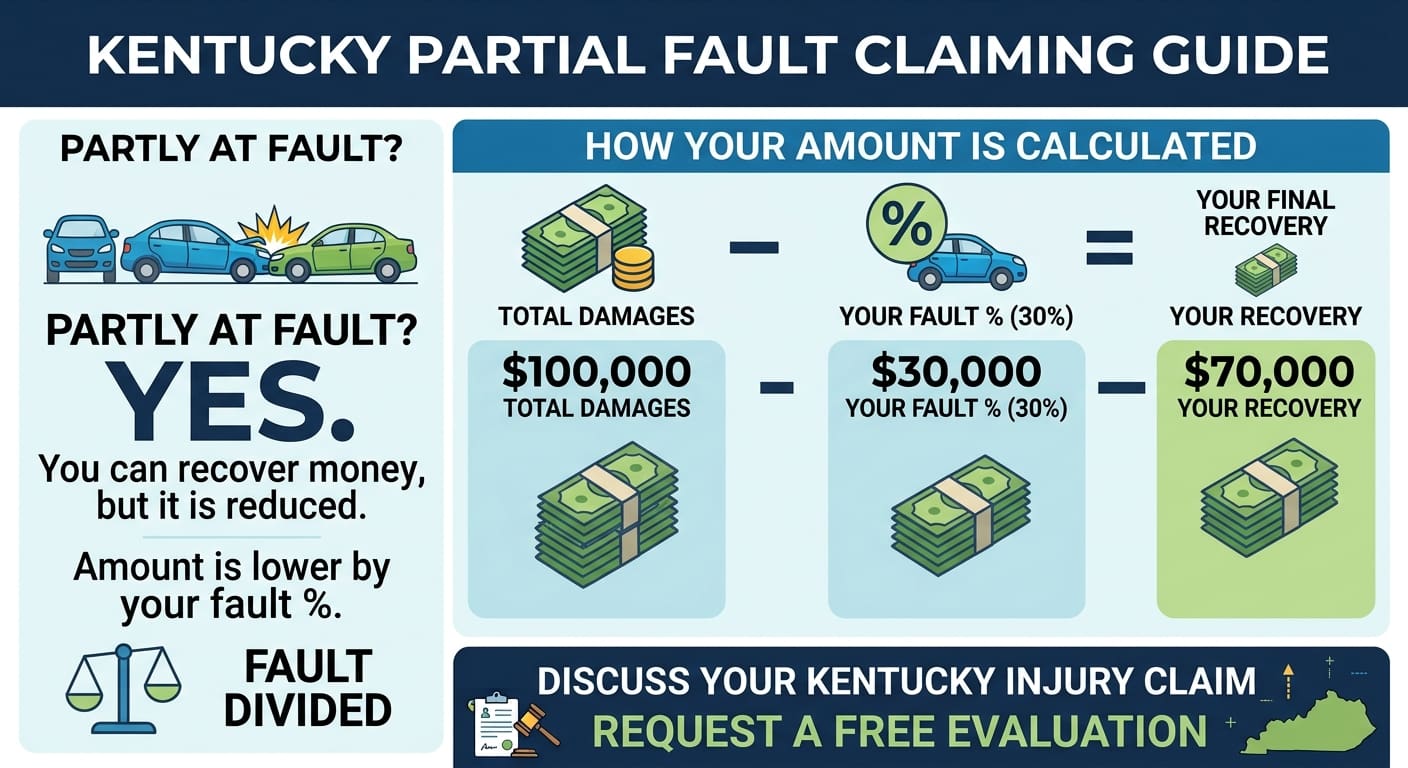
Kentucky’s comparative-fault statute requires that fault be allocated by percentage when more than one party is at fault in a tort action. When assigning percentages of fault, the fact-finder considers each party’s conduct and how directly that behavior contributed to the claimed damages.
As a result, responsibility for an intersection crash may be divided between multiple parties instead of assigned entirely to one.
What Evidence Can Help Establish Fault After an Intersection Crash?
Because intersection crashes often involve conflicting accounts, objective evidence can become especially important. Useful evidence to collect may include:
- Traffic-camera, surveillance, or dashcam video
- Photographs of vehicle positions, damage, debris, lane markings, and traffic signals
- Names and contact information for independent witnesses
- The timing and sequence of the traffic lights
- Vehicle data that may help show movement before impact
- The police collision report and any diagrams or recorded observations
A Kentucky accident report serves as an important starting point for documenting what people reported and observed. Drivers can also review how to obtain a Kentucky accident report and address possible errors if the report contains inaccurate identifying or factual information.
No single piece of evidence necessarily decides fault by itself in an intersection crash. The strongest assessment usually comes from comparing the physical evidence, traffic rules, witness information, and each driver’s actions as a complete record.
Talk to Forman & Associates About an Intersection Crash in Kentucky
Fault after an intersection crash in Kentucky can depend on details that are easy to miss, especially in a left-turn, red-light, or T-bone crash where the drivers disagree about who had the right-of-way. Evidence may also support shared responsibility rather than placing all fault on one person.
For Kentucky injury matters, Forman & Associates can evaluate the facts and provide guidance on how traffic rules and comparative fault may shape the claim in an intersection crash. Schedule a free case evaluation with us to review what happened and identify evidence that could be important to your case.