A $4.3 million award against the self-described largest injury law firm in America is putting a basic part of the attorney-client relationship back in the spotlight: the client is supposed to remain in control of major decisions, even when a firm handles cases on a massive scale.
The Morgan & Morgan arbitration arose from a former client’s claim that the firm settled his injury case for $45,000 without his permission. Morgan & Morgan strongly disputes that account and says the client verbally consented to the settlement. Even with that disagreement, the size of the award raises an important question for injured people in Kentucky and elsewhere: Does hiring the biggest firm necessarily mean getting the attention your case deserves?
What Happened in the $4.3 Million Arbitration?
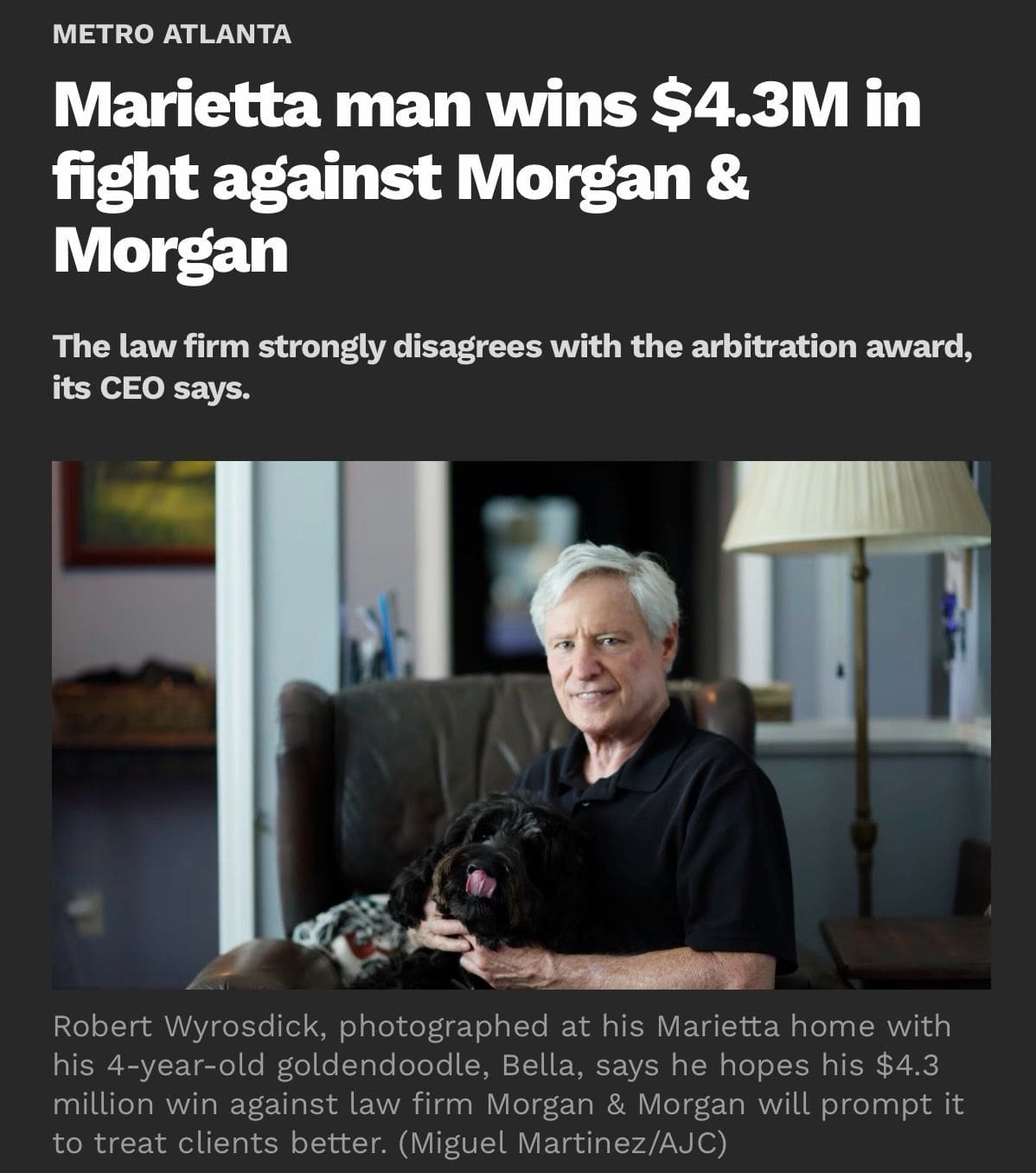
The reported arbitration dispute began after Robert Wyrosdick hired Morgan & Morgan following a March 2023 rear-end collision that injured his back. His lawsuit was filed in Georgia later that year.
Wyrosdick alleged that he had little communication with the attorney assigned to his case and that the matter was settled for $45,000 in early 2024 without his knowledge or permission. Morgan & Morgan and former firm attorney Corey Aitken maintained that Wyrosdick verbally agreed to the settlement and later objected to it.
Arbitrator Erika Birg issued the Morgan & Morgan arbitration award in July 2026. She granted Wyrosdick’s claims for legal malpractice, breach of contract and breach of fiduciary duty against Morgan & Morgan and Aitken. The award included $450,000 in compensatory damages, $250,000 for emotional distress, more than $400,000 in attorney fees and costs and $3.15 million in punitive damages.
Birg was not tasked with explaining the reasoning behind her findings. The award therefore should not be treated as proof that every allegation Wyrosdick made about Morgan & Morgan’s broader business model was accepted by the arbitrator.
Morgan & Morgan Disputes the Client’s Account
Morgan & Morgan has publicly pushed back on the result. CEO Alexander Clem told the AJC that the firm strongly disagreed with the arbitration findings. Morgan & Morgan and Aitken maintained in an arbitration brief that Wyrosdick verbally consented to the settlement.
Clem also rejected the idea that the case showed a widespread problem at Morgan & Morgan. He argued that mistakes can occur at firms of any size and emphasized the firm’s stated commitment to transparency and client communication.
Those points matter. A single arbitration cannot establish how every client is treated across a national law firm. At the same time, an award granting claims for malpractice, breach of contract and breach of fiduciary duty is a serious event that prospective clients can reasonably consider when deciding what kind of attorney-client relationship they want.
From “For the People” to “For the Profit”?
Morgan & Morgan openly markets itself as America’s largest injury law firm and says its size allows it to help more people in more places. The firm also prominently uses its “Fighting for the People” message.
Size is not inherently a problem. A large personal injury law firm can have extensive resources, experienced lawyers and systems that benefit clients. The concern arises when case volume becomes more important than communication and individual attention.
Wyrosdick alleged that Morgan & Morgan attorneys were overloaded with cases, that non-attorney staff handled much of the work and that lawyers were incentivized to settle cases quickly at high volume. Morgan & Morgan disputes the suggestion that his experience reflects the firm more broadly.
The Morgan & Morgan legal malpractice dispute does not prove that every large firm puts profits before people. It does show why “biggest” should never be treated as a substitute for asking how a firm will actually handle an individual case. For the people can start looking like for the profit when a client becomes primarily a case number rather than a participant in major decisions.
Kentucky Clients Should Remain in Control of Major Decisions
The arbitration involved a Georgia case, so it does not establish Kentucky law. Kentucky’s own professional conduct rules still make the underlying client-service issues especially relevant.
Under Kentucky’s professional conduct rules, a lawyer must abide by the client’s decision on whether to settle a matter. The rules also require lawyers to keep clients reasonably informed about the status of a case, respond to reasonable requests for information and explain matters enough for clients to make informed decisions.
A lawyer may handle negotiations, evidence, filings and strategy, but settlement is not simply an administrative decision to make because it moves a file off a desk. Clients should understand significant developments in their cases and have the opportunity to make informed decisions about settlement offers.
Questions to Ask Before Hiring an Injury Firm
Morgan & Morgan’s $4.3 million arbitration offers a useful reminder that advertising reach is not the same thing as attorney access. When choosing a personal injury lawyer, prospective clients should understand how the firm actually manages cases before signing an agreement.
Useful questions include:
- Who will be the attorney primarily responsible for my case?
- How often should I expect updates?
- Will I be able to speak directly with my attorney when necessary?
- Who will communicate settlement offers to me?
- What happens if I do not want to accept an offer?
- Will most of my communication be with a lawyer, a case manager or another staff member?
No firm should be judged solely by its size in either direction. A small firm can provide poor service and a national firm can provide excellent representation. The meaningful issue is whether the structure of the firm gives each client the attention, communication and decision-making role the case requires.
Being the Biggest Is Not the Same as Being the Right Fit
Personal injury advertising often emphasizes recoveries, resources, reach and scale. Injured people should look beyond those claims and ask a more practical question: Who is actually going to know my case?
The Morgan & Morgan arbitration is a reminder of what can go wrong when a client believes a major decision was made without meaningful involvement. Forman & Associates describes itself as not a volume firm and emphasizes direct access to its legal team.
Kentucky injury victims who want to discuss how their case would be handled can request a free case evaluation with Forman & Associates. A consultation can help a prospective client understand the process, who will be involved and what to expect before deciding whom to hire.