Kentucky changed several important rules governing personal injury protection in 2026. The Kentucky PIP law changes affect how certain medical expenses are paid, how much may be paid each week for work loss and related losses, and how quickly medical providers generally must submit charges.
The changes come from House Bill 627, which became law without the governor’s signature on April 14, 2026. They do not replace Kentucky’s existing no-fault system or increase the standard $10,000 total limit for basic reparation benefits.
Drivers who want a broader overview can first review how Kentucky no-fault insurance and PIP benefits generally work after a crash.
When the 2026 Kentucky PIP Law Changes Apply
The effective date is only part of the timing question. The current KRS 304.39-130 sets the weekly limit for certain losses at $500, states an effective date of July 15, 2026, and includes a Legislative Research Commission note explaining that the 2026 amendments apply to basic and added reparation benefits issued or renewed on or after that date.
The fact that an accident happened after July 15 does not automatically mean the new rules apply to the claim. The effective or renewal date of the applicable coverage may also matter.
For drivers comparing old and new coverage, the most practical changes involve weekly work-loss limits, funeral expenses, medical-payment amounts, and provider billing procedures.
The $10,000 Basic PIP Limit Did Not Increase Per the PIP Law Changes
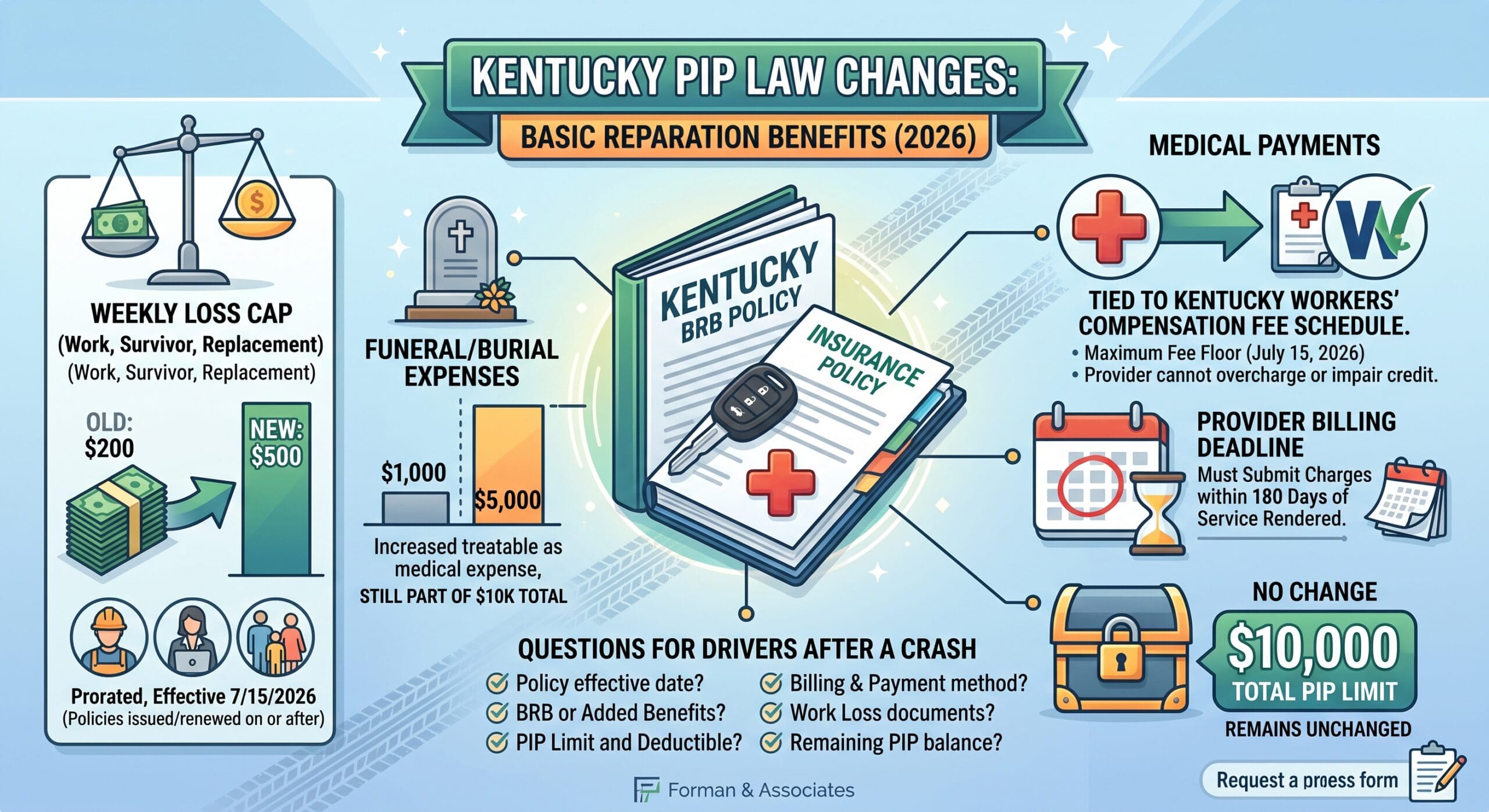
Kentucky still defines basic reparation benefits, commonly called “PIP,” as reimbursement for certain economic loss arising from a motor-vehicle injury. The maximum amount of basic reparation benefits remains $10,000 for all covered economic loss resulting from injury to one person in one accident.
The enacted HB 627 changes in Acts Chapter 149 left that overall $10,000 limit unchanged while increasing the weekly cap for work loss, survivor’s economic loss, replacement services loss, and survivor’s replacement services loss from $200 to $500, prorated for a shorter period.
The law also increased the amount that may be treated as a medical expense for funeral, cremation, and burial charges from $1,000 to $5,000 per person.
The $5,000 is not an additional benefit paid beyond the basic PIP amount, as it remains part of the statutory definition of loss and is subject to the applicable basic reparation benefit limit.
Medical Payments Are Now Tied to a Fee Schedule Per the New PIP Law Changes
One of the more technical changes to basic reparation benefits in Kentucky involves the amount an insurer or other reparation obligor pays for covered medical expenses.
Under the amended KRS 304.39-020, covered medical expenses paid by a reparation obligor or its third-party administrator are tied to the relevant schedule of fees established under Kentucky’s workers’ compensation law.
The statute generally prevents payment above the applicable maximum fee in effect when the medical expense is incurred. It also establishes a floor based on the maximum fee listed in the schedule that was in effect on July 15, 2026.
The provision does not increase the basic PIP cap beyond $10,000. Instead, it changes the rules used to determine what amount may be paid for certain medical charges.
Because PIP is a limited pool of benefits, how individual medical expenses are paid can affect how quickly available benefits are used.
Providers Generally Have 180 Days to Submit Medical Charges per the New PIP Law Changes
The 2026 amendments also added a specific billing deadline for medical providers. Under amended KRS 304.39-210, a person providing a covered product, service, or accommodation generally must submit the charge within 180 days after the service is rendered.
The statute contains an exception for charges submitted under KRS 304.39-241. The same section adds protections involving charges above the applicable fee-schedule amount.
When a medical expense is covered by a reparation obligor, a provider may not knowingly try to collect from the insured the portion above the statutory maximum fee. The provider also may not impair the insured’s credit because the insured refuses to pay that excess balance.
Those rules are specific to charges covered under the statute. They should not be read as a universal rule that every medical balance after a car accident must disappear.
What Kentucky Drivers Should Check After a Crash Knowing the New PIP Law
The most important practical point is that the Kentucky PIP law changes did not create an entirely new insurance system. They changed how parts of the existing system operate.
After a crash, an injured person may want to confirm:
- The effective and most recent renewal date of the applicable auto policy
- Whether basic or added reparation benefits apply
- The available PIP limit and any deductible
- How medical bills are being submitted and paid
- What documentation is required for claimed work loss
- How much of the available PIP balance has already been used
A dispute over medical billing, work loss, or the remaining PIP balance can affect a broader Kentucky car accident claim, but PIP coverage and liability against another driver remain separate legal questions. The applicable policy, timing of the renewal, and facts of the collision can all affect the analysis.
Get Help Understanding the 2026 Kentucky PIP Law Changes
The 2026 changes to basic reparation benefits in Kentucky can make PIP claims more complicated, especially when a policy is renewed around the July 15 effective date or when medical charges and work-loss benefits are disputed. Forman & Associates can review the facts of a Kentucky injury matter, the applicable coverage, and how the current PIP rules may affect the claim. To discuss the situation, request a free case evaluation with us today.